Why we exist
Social Impact
We address global challenges in
healthcare access through a business
built for impact.
Noul is a social mission venture established to solve global access challenges in blood and cancer diagnostics.
The conventional diagnostic system, centered on large central labs, has created structural barriers to access for more than half a century across high-, middle- and low-income countries alike. To overcome these limitations, Noul translates the concept of Decentralized Diagnostics*—distributing high-quality diagnostic capabilities to the field—into products and services.
By scaling a diagnostic system that fundamentally reduces reliance on specialized personnel, costly equipment, and essential infrastructure worldwide, we aim to contribute to innovation in healthcare access by enabling fast and accurate diagnosis even in settings with limited medical infrastructure.
Noul's ultimate goal is to bring reliable diagnostic services to more than one billion people worldwide who remain underserved by diagnostics.
How we innovate
Deep Tech
We advance blood and cancer
diagnostics through the convergence
of AI, biotechnology, and robotics.
There are two major challenges in realizing decentralized diagnostics: the "on-site automation" of complex diagnostic processes and the "assurance of diagnostic accuracy" in environments without experts or infrastructure.
Noul overcomes both barriers through the convergence of AI, biotechnology, and robotics. Noul's solid staining technology, NGSI™*, is an innovative lab-on-a-chip technology that fundamentally eliminates dependence on the infrastructure required by conventional staining methods. Combined with microrobotics, it automates the entire process of generating cell images.
Additionally, Noul's proprietary on-device AI model reads the generated images in real time and provides reliable and accurate diagnostic results within 15 minutes. In this way, Noul is accelerating systemic change in global healthcare settings by resolving the dilemma between accuracy and accessibility through innovative technology.
What we deliver
Lab-in-a-Box
We deliver a highly scalable, fully
automated diagnostic platform
accessible at any level of care.
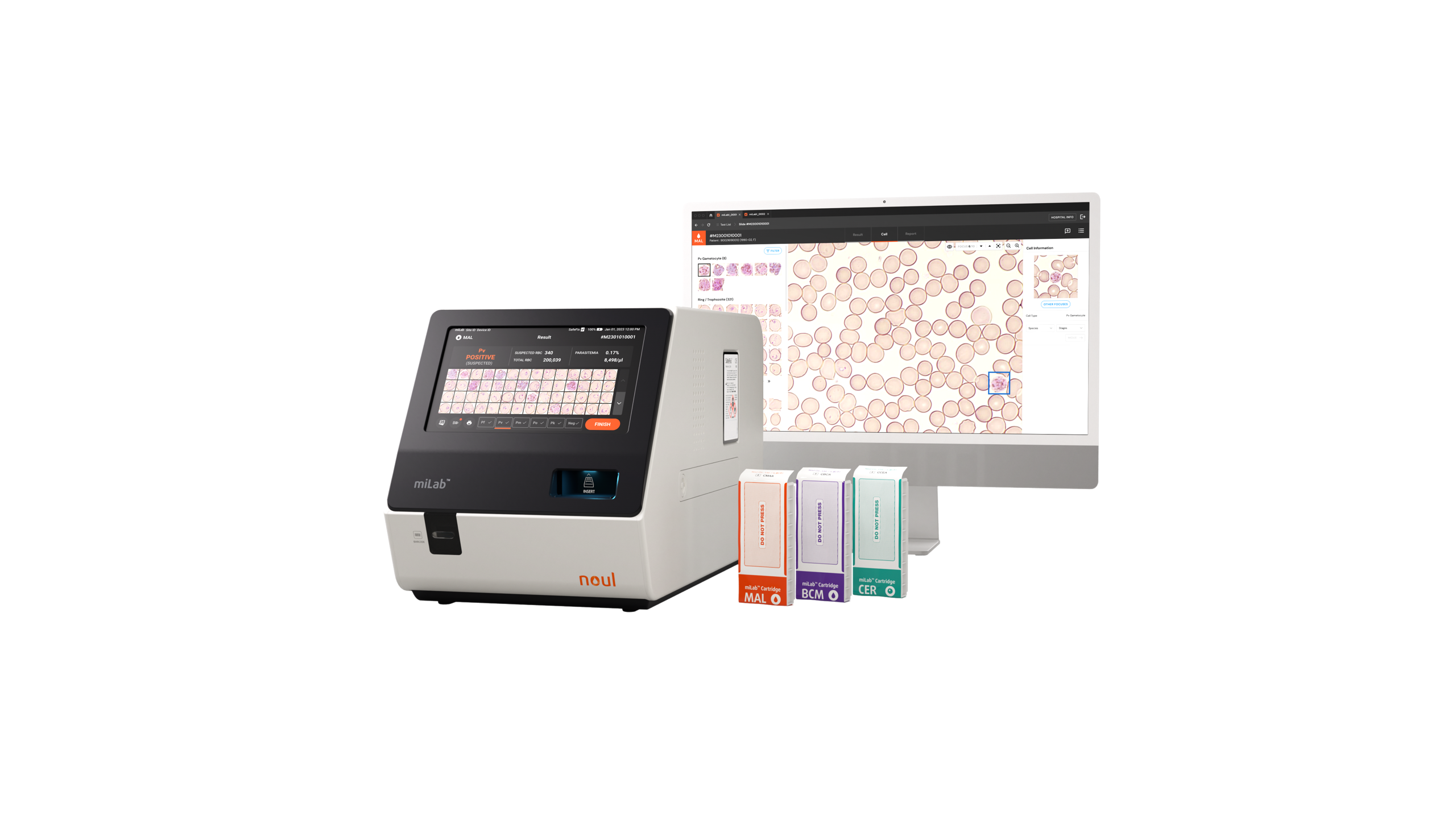
Noul’s miLab™ is an AI-based decentralized diagnostic platform that automates the entire diagnostic process, from sample preparation and staining to imaging and AI interpretation.
miLab™ has two device lineups specialized for blood and tissue applications tailored to specimen characteristics, and each device can perform various tests, including malaria (MAL), blood analysis (BCM) and cervical cancer screening (CER), simply by replacing the cartridge. Based on the same platform, it can also be readily expanded into adjacent testing areas such as immunopathology, cell therapy monitoring and breast cancer.
In particular, Noul's proprietary platform architecture based on on-device AI and microrobotics makes a true Lab-in-a-Box a reality, greatly expanding access to diagnostics while significantly improving operational efficiency in healthcare settings. Through the global distribution of miLab™, Noul will help make high-quality point-of-care diagnostic services a reality for one billion people.
*Decentralized diagnostics is an innovative technology that overcomes the trade-off between diagnostic accessibility and accuracy, enabling the same level of precision found in major hospitals at highly accessible settings such as local clinics. Achieving decentralized diagnostics requires the convergent implementation of high-accuracy on-device AI, lab-on-a-chip technology that replaces conventional laboratory infrastructure, real-time remote communication, and hardware that fully automates the core processes of specific diagnostic tests.
*NGSI™(Next Generation Staining and Immunostaining) is a staining method in which a hydrogel containing staining reagents is pressed onto a specimen like a stamp. It replaces the liquid staining method that has been used in blood and tissue diagnostics for over 100 years, and is a proprietary technology held exclusively by Noul worldwide.
Noul at a Glance
Products
miLab™ CER
Cervical Cancer Screening
miLab™ MAL
Malaria Diagnostics
miLab™ BCM
Blood Count & Morphology
Global Presence
· Africa 31%, Europe 25%, Asia 16%, Middle East 16%, North America and Latin America 13%
· High-income countries 47%, upper-middle-income countries 31%, lower-middle-income countries 22%
Patent Portfolio
25 filed
Cumulative
Global Bases
Headquarters
South Korea
International Subsidiary
Switzerland
Local Expert Team
- Europe: Germany, the United Kingdom, France
- Latin America: Mexico, Brazil
2025 Revenue
Approximately 319% year-on-year growth
Hybrid Business Model
Noul pursues a hybrid model that creates both social and economic value through an innovative business that contributes to solving global health challenges.
Mission
We explore challenging problems that threaten human health and life, discover new ways to solve them and bring their possibilities to life.
Business Strategy
Product portfolio
Development of next-generation diagnostic test anchor pipelines (MAL, BCM, CER) → Expansion of platform-based testing areas (infectious diseases, immunopathology, cell therapy, cancer type expansion, etc.)
Market positioning
Securing category leadership based on a technology moat (First-In-Class, Only-In-Class) → Maintaining the leading position in the market through product advancement (Best-In-Class)
Growth strategy
Securing high-impact partners → Building top-tier references →Scaling up and data lock-in → Building an AI-based global data platform
Ambition 2030
We will grow into a global healthcare company by providing products and services that can create impact in the lives of one billion people worldwide.
People worldwide remain excluded from basic medical services and disease diagnosis
2.5 billion
1.8 billion
Lower-middle-income and low-income countries
700 million
High-income and upper-middle-income countries
Root causes we focus on
Impacts of the problem
AI-based decentralized diagnostic platform miLab™
Accessibility
Highly accurate blood and tissue (cell) diagnostic testing even in settings with limited healthcare infrastructure
Workflow
Fully automated testing performed more than twice as fast as conventional methods while minimizing environmental impact
Scalability
Expandable from a single device to diverse testing areas
Digitalization
Digital image storage and transmission & remote interpretation of test results
Medical institutions
Healthcare systems
Environment
Contributing to UN SDG 3
Good Health and Well-being
Expanded opportunities for early disease detection and treatment
Reduced diagnostic time and cost
Patients
Improved access to timely, high-quality diagnostic testing